
Malaysia’s vibrant cultural landscape is shaped by centuries-old recreational activities that bring together communities across generations. Traditional games in Malaysia are more than just entertainment—they embody historical narratives, social bonds, and regional identity preserved through practice and learning. From wooden boards and marble stones to handcrafted kites and spinning tops, these activities reflect Malay, Chinese, Indian, and indigenous customs that continue to thrive in villages, schools, and cultural festivals. Alongside traditional forms of leisure, the modern digital segment is also rapidly developing today, with leading online betting platforms like Dashking 88 offering players a wide selection of entertainment, high odds, and convenient conditions. This study covers the origins, gameplay, and modern revival of Malaysia’s traditional games that define the nation’s heritage.
What Are Traditional Games in Malaysia?
Traditional games in Malaysia encompass a diverse collection of physical and strategic activities passed down through oral tradition and communal practice. These malaysia games include board-based challenges like Congkak, athletic competitions such as Sepak Takraw, skill-driven crafts like Wau kite flying, and children’s pastimes such as Batu Seremban. Each activity carries distinct rules, equipment, and cultural significance tied to specific ethnic groups or regional communities.
Players engage with natural or handcrafted materials—rubber seeds, bamboo sticks, woven rattan balls, painted paper kites—that reflect local resources and artisan traditions. Unlike modern digital entertainment, malaysia traditional games prioritize face-to-face interaction, outdoor environments, and collective participation. Strategic games like Main Chongkak develop mathematical reasoning and pattern recognition. Athletic pursuits such as Gasing improve hand-eye coordination and balance. This multifunctional character ensures traditional games in malaysia remain relevant in educational curricula and cultural preservation programs.
The History of Traditional Malaysian Games
Historical records trace malaysia games to pre-colonial settlements where Malay, Orang Asli, and maritime traders shared recreational practices across the archipelago. Archaeological evidence from Kedah and Perak includes stone game boards dating to the 10th century, suggesting early adoption of strategic pastimes among coastal communities. The Malacca Sultanate era further popularized Sepak Raga and Gasing spinning during royal festivities, embedding these activities in court culture.
Colonial influences introduced European sports but failed to displace indigenous traditions. British administrators documented local competitions in 19th-century reports, noting village tournaments for top spinning and kite flying in Kelantan and Terengganu. Post-independence Malaysia recognized traditional games as national heritage. The Ministry of Culture established competitions and exhibitions in the 1970s, formalizing rules and sponsoring inter-state tournaments. Migration patterns also shaped game diversity, with Chinese settlers bringing dice-based games while Indian communities introduced board strategies. Indigenous groups contributed hunting-simulation games tied to jungle survival, creating a hybrid recreational culture unique to the Malaysian peninsula.
Congkak and Its Cultural Significance
Congkak stands as one of the most recognizable traditional games in Malaysia, played on a carved wooden board featuring two rows of circular pits and larger end reserves. Two players distribute rubber seeds or marbles counterclockwise, capturing opponent pieces through strategic pit selection. Gameplay demands arithmetic calculation, spatial reasoning, and anticipation of the opponent’s moves across multiple rounds.
The game’s origins trace to ancient mancala variations practiced across Africa and Southeast Asia. Malaysian versions evolved distinct regional rules—Kelantan players use nine pits per row, while Selangor variants employ seven. Artisans carve boards from hardwoods like cengal or merbau, often decorating surfaces with floral motifs and geometric patterns that reflect Malay craftsmanship traditions.
Congkak holds deep social significance in Malay communities. Families gather during Hari Raya and wedding celebrations to compete across age groups, with elders teaching children counting techniques and tactical patience. Schools incorporate Congkak into mathematics curricula, using gameplay to illustrate addition, subtraction, and probability concepts. Modern tournaments attract participants from across Malaysia, with state-level competitions offering trophies and cultural recognition. Museums in Kuala Lumpur and Malacca display antique boards, preserving the aesthetic evolution of this malaysia traditional game.
Sepak Takraw and Traditional Ball Games
Sepak Takraw combines elements of volleyball, soccer, and gymnastics, played with a woven rattan ball across a high net. Three-player teams execute acrobatic kicks, headers, and spikes to score points, showcasing athletic agility and teamwork. The sport originated in Malay kingdoms as Sepak Raga, where players formed circles to keep the ball airborne using only feet, knees, chest, and head.
Historical texts from the 15th century describe royal courts hosting Sepak Raga exhibitions during state ceremonies. The transition to competitive net play occurred in the early 20th century when standardized rules emerged. Malaysia formed national associations in 1960, establishing training academies and sponsoring international championships that spread the game globally.
Traditional rattan balls require specialized weaving skills passed through apprenticeship. Modern balls use synthetic materials for durability, though purists prefer natural rattan for its weight balance and flight predictability. Sepak Takraw exemplifies how malaysia games transition from folk pastimes to professional sports. The Asian Games and Southeast Asian Games feature the sport, with Malaysian teams earning multiple gold medals. Village tournaments persist alongside elite competitions, maintaining grassroots participation. Youth programs introduce Sepak Takraw in schools, ensuring new generations inherit the athletic traditions embedded in this traditional game.
Gasing: Traditional Top Spinning
Gasing, the art of top spinning, represents a skill-intensive malaysia traditional game practiced primarily in rural Kelantan, Terengganu, and Melaka. Players launch heavy wooden tops—some weighing up to five kilograms—using rope techniques that require strength, timing, and balance. Competitions measure spin duration, with record attempts exceeding two hours for expertly crafted tops and skilled throwers.
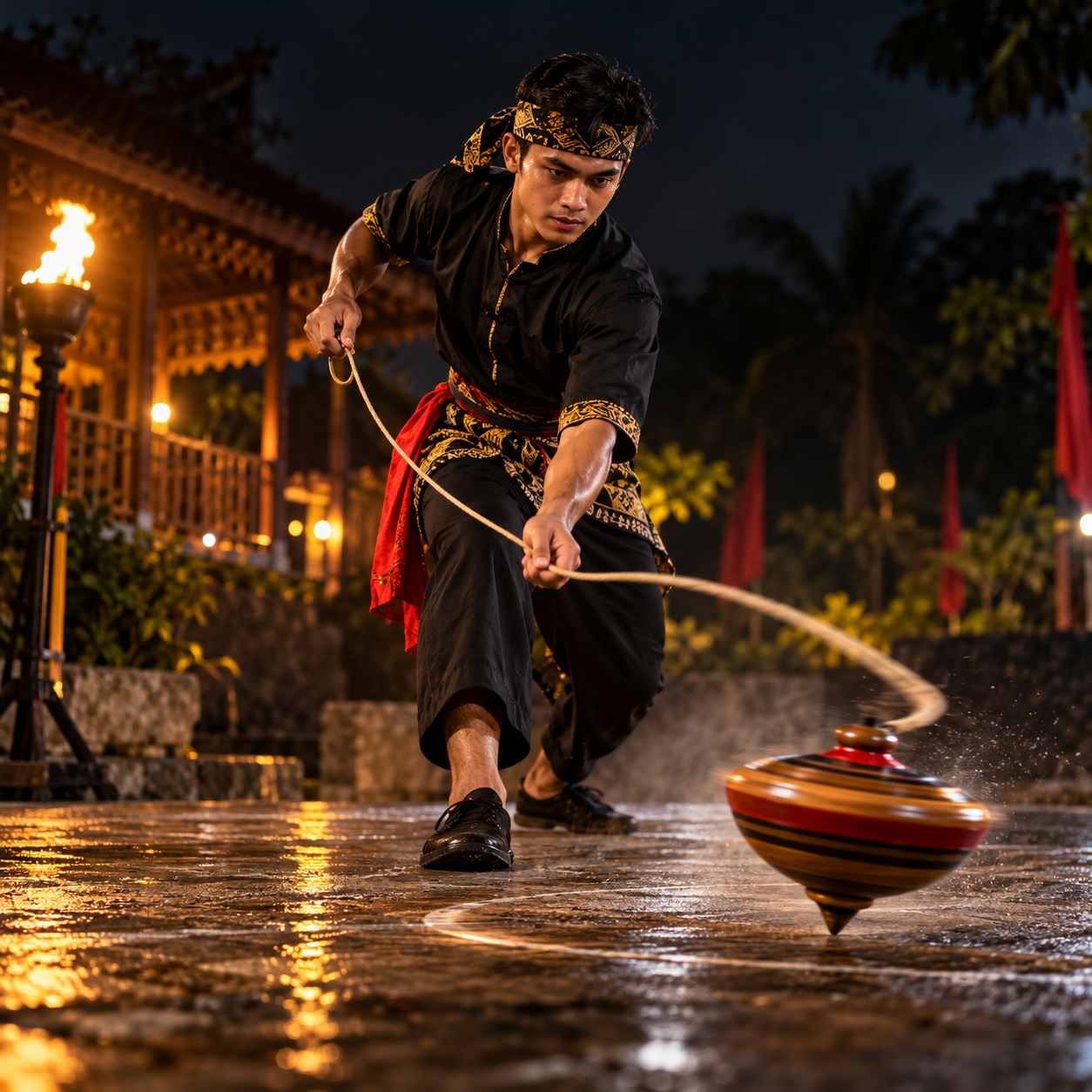
Artisans carve tops from hardwoods such as jati or belian, shaping conical bodies with iron tips for stability. Designs vary by region: Kelantanese tops feature larger diameters for prolonged spins, while Melakan variants emphasize decorative carvings and painted patterns. The crafting process involves seasoning wood for months, balancing weight distribution, and polishing surfaces to reduce friction.
Throwing techniques distinguish novice from master players. Competitors wrap cotton or nylon rope around the top’s grooves, then hurl it onto a raised platform while releasing the cord with precise tension. Gasing tournaments coincide with harvest festivals and state cultural celebrations, drawing participants from across Malaysia. The game embodies values of patience, craftsmanship, and community pride. Schools integrate Gasing demonstrations into cultural education programs, teaching students physics principles of angular momentum and friction through hands-on play.
Wau: The Art of Malaysian Kite Flying
Wau kite flying elevates traditional games in Malaysia to an artistic and engineering discipline. Named for their crescent moon shape resembling the Arabic letter “wau,” these kites span up to 3.5 meters in width and feature intricate designs painted on bamboo frames covered with colorful paper or cloth. Five major types exist: Wau Bulan, Wau Kucing, Wau Merak, Wau Jala Budi, and Wau Bunga, each associated with specific regions and symbolic meanings.
Artisans construct Wau kites using bamboo strips for framing, paper or fabric for surfaces, and natural dyes for decoration. The process demands geometric precision—improper weight balance or asymmetric framing causes unstable flight. Decorative motifs include floral patterns, mythical creatures, and Islamic calligraphy, reflecting Malay aesthetic traditions. Builders attach bamboo strips to the kite’s tail, creating a humming sound during flight that gives Wau its distinctive auditory signature.
Flying techniques require understanding wind patterns, string tension, and launch angles. Competitions judge kites on height achieved, flight duration, design aesthetics, and sound quality. The annual International Wau Festival in Kelantan attracts participants from Thailand, Indonesia, and Singapore, showcasing regional variations and innovations in kite design. Wau kites hold ceremonial significance beyond recreation. Farmers historically flew kites after rice harvests to celebrate successful yields and favorable weather, symbolizing freedom and connection between earth and sky. Museums preserve antique Wau specimens, while workshops teach younger generations the construction techniques that sustain this malaysia traditional game.
Batu Seremban and Other Children’s Games
Batu Seremban, a dexterity game using five small stones or cloth bags filled with sand, remains popular among Malaysian children and adults. Players toss one stone upward while rearranging the remaining pieces on the ground, then catch the airborne stone before it falls. Progressive levels increase complexity—players must flip stones, stack them in specific patterns, or catch multiple pieces simultaneously. Success demands hand-eye coordination, rhythm, and spatial awareness.
The game’s portability and minimal equipment requirements enabled widespread adoption across rural and urban communities. Players often craft stones from river pebbles or sew cloth pouches filled with rice grains, personalizing their sets with embroidery and decorative stitching. Competitive rounds involve multiple players taking turns, with elimination rules determining winners based on accuracy and speed through all levels.
Other children’s games include Galah Panjang, a chasing game where teams defend grid zones drawn on the ground, and Capteh, played with a feathered shuttlecock kicked to stay airborne. These activities require no expensive equipment, relying instead on natural materials and open spaces. Schools incorporate malaysia games like Batu Seremban into physical education programs, recognizing their benefits for motor skill development and cultural literacy. Parents and grandparents share gameplay techniques, creating intergenerational learning experiences that reinforce family bonds and cultural continuity.
Traditional Games Across Different Malaysian Communities
Malaysia’s multicultural society sustains diverse traditional games reflecting Malay, Chinese, Indian, and indigenous traditions. Malay communities favor outdoor activities like Sepak Takraw, Gasing, and Wau, emphasizing physical skill and communal participation. Chinese Malaysians practice tile-based games and strategic board games during festivals such as Lunar New Year, blending recreation with family gatherings.
Indian communities preserve games like Pallanguzhi, a mancala variant similar to Congkak. These activities accompany Deepavali and Pongal celebrations, reinforcing cultural identity. Indigenous groups maintain hunting-simulation games, blowpipe accuracy contests, and nature-based challenges tied to jungle survival skills and ancestral knowledge.
Urban areas witness cross-cultural exchanges where children learn games from multiple traditions. Schoolyards host Congkak alongside Chinese shuttlecock games, while community centers organize multi-ethnic tournaments. This blending creates a hybrid recreational culture unique to Malaysia, fostering mutual understanding and shared heritage appreciation. Regional variations also distinguish gameplay, with Kelantanese communities emphasizing Gasing and Wau, while Sabah and Sarawak maintain indigenous games rarely seen in peninsular Malaysia.
Festivals, Schools, and Cultural Events
Traditional games in Malaysia feature prominently in national and state-level festivals celebrating cultural heritage. The Pesta Kaamatan in Sabah and Gawai Dayak in Sarawak incorporate indigenous games into harvest celebrations. Hari Kebangsaan events showcase Congkak, Sepak Takraw, and Wau demonstrations, reinforcing these activities as symbols of Malaysian identity.
The Malaysian government sponsors annual competitions such as the National Gasing Championship and International Wau Festival, offering prize money and cultural recognition to winners. These events standardize rules, document gameplay techniques, and promote inter-state rivalries that maintain public interest. Media coverage broadcasts tournaments nationally, exposing urban populations to rural traditions.
Schools integrate malaysia games into curricula through co-curricular programs and sports days. Teachers organize Congkak mathematics lessons, Sepak Takraw physical education classes, and Wau art projects that connect traditional activities to academic subjects. The Ministry of Education publishes instructional manuals and training videos, ensuring consistent teaching standards across regions. Cultural centers and museums host workshops where master artisans teach kite construction and game strategies to younger generations. These programs address declining rural populations and urbanization trends that threaten transmission of traditional skills.
Preserving Traditional Games in Modern Malaysia
Urbanization, digital entertainment, and changing lifestyles challenge the continuity of traditional games in malaysia. Rural depopulation reduces the transmission of skills from elders to youth, while smartphone gaming competes for children’s attention. Recognizing these threats, government agencies, NGOs, and cultural organizations implement preservation initiatives targeting schools, communities, and media platforms.
The National Heritage Department catalogs traditional games as intangible cultural heritage, documenting rules, equipment, and regional variations in official registries. Digital archives store video recordings of expert gameplay, artisan techniques, and oral histories from veteran players. Schools receive funding for traditional game equipment—Congkak boards, Sepak Takraw balls, Gasing tops—enabling hands-on learning without financial barriers. Teachers attend training workshops to master gameplay and instructional methods, then incorporate activities into weekly schedules.
Social media campaigns and television programs promote malaysia traditional games to younger audiences. Viral videos demonstrate acrobatic Sepak Takraw moves, Gasing spin records, and Wau kite festivals, attracting millions of views and sparking renewed interest. Mobile apps now offer digital versions of Congkak and Batu Seremban, introducing gameplay mechanics to tech-savvy generations while encouraging physical play.
Community organizations establish heritage clubs where enthusiasts practice and teach traditional games. These groups organize weekend tournaments, cultural exhibitions, and international exchanges with neighboring countries sharing similar traditions. Collaborations with tourism boards position malaysia games as attractions for domestic and foreign visitors, generating economic incentives for preservation. Workshops in Malacca, Penang, and Kuala Lumpur offer tourists hands-on experiences, converting cultural heritage into sustainable livelihoods for artisans and instructors.
FAQ
What are the most popular traditional games in Malaysia?
The most popular traditional games in Malaysia include Congkak, Sepak Takraw, Gasing, Wau kite flying, and Batu Seremban. Congkak is a strategic board game using seeds or marbles. Sepak Takraw is an athletic ball game combining kicks and acrobatics. Gasing involves spinning heavy wooden tops for duration records. Wau showcases decorative kite flying with musical elements. Batu Seremban is a dexterity challenge using small stones. Each activity reflects specific regional and ethnic traditions across Malay, Chinese, Indian, and indigenous communities.
Where can I experience malaysia traditional games in person?
You can experience malaysia traditional games at national festivals, cultural centers, and heritage museums. The International Wau Festival in Kelantan and National Gasing Championship feature live competitions. Museums in Malacca, Kuala Lumpur, and Penang offer interactive exhibits and workshops. Schools and community centers organize demonstration events during National Day and state celebrations. Tourist-focused programs in Malacca and Penang provide hands-on lessons in Congkak, Batu Seremban, and kite construction.
How do schools teach traditional games in Malaysia today?
Schools teach malaysia games through co-curricular programs, physical education classes, and cultural workshops. The Ministry of Education provides instructional manuals, equipment grants, and teacher training for Congkak, Sepak Takraw, and other activities. Students participate in inter-school tournaments earning certificates and trophies. Mathematics teachers use Congkak for counting lessons, while art classes incorporate Wau kite design projects. This integration ensures traditional games in malaysia remain accessible to younger generations despite digital competition.
Are traditional games in Malaysia still practiced in villages?
Yes, traditional games in Malaysia remain actively practiced in villages, particularly in Kelantan, Terengganu, and rural Sabah and Sarawak. Gasing tournaments coincide with harvest festivals, drawing community participation. Wau kite flying continues during post-harvest celebrations. Congkak and Batu Seremban are played during family gatherings and religious holidays. However, urbanization and migration reduce the number of practitioners, prompting preservation programs to maintain village-based traditions through cultural clubs and government-sponsored events.
What materials are needed to play malaysia traditional games?
Materials for malaysia traditional games vary by activity but emphasize natural and handcrafted components. Congkak requires a wooden board and rubber seeds or marbles. Sepak Takraw uses a woven rattan ball and net. Gasing needs carved wooden tops, rope, and a platform. Wau kite flying involves bamboo frames, paper or cloth, and decorative paint. Batu Seremban uses five small stones or cloth bags filled with sand. These materials are often locally sourced and crafted by artisans, preserving traditional production techniques.
Can foreigners participate in traditional game competitions in Malaysia?
Foreigners can participate in traditional game competitions in malaysia, particularly during international festivals and cultural events. The International Wau Festival welcomes participants from Thailand, Indonesia, and Singapore. Tourist programs in Malacca and Penang offer workshops where visitors learn Congkak, Batu Seremban, and kite flying. Some community tournaments allow open registration for Sepak Takraw and Gasing, though competitive levels require advanced skills. Cultural centers provide beginner sessions enabling tourists to experience malaysia traditional games regardless of prior knowledge.
Remember: Participation in traditional games should respect cultural protocols and safety guidelines. Activities involving physical exertion require appropriate fitness levels. Always engage with licensed cultural programs and community organizations. Traditional games in malaysia are cultural heritage meant for responsible enjoyment and preservation.